VFD Bearing Currents: How to Investigate Repeat Motor Bearing Failures
- 2026 Nov 26
Learn how VFD bearing currents can damage motor bearings, which evidence to keep, and how to distinguish electrical erosion from mechanical wear.

To investigate VFD bearing currents after repeat motor bearing failures, compare three kinds of evidence: damage on the old bearing, the timeline of noise and equipment changes, and the possible high-frequency current path. Noise or a fluted raceway alone cannot establish the cause, and a drive without a fault code does not rule out electrical erosion. Preserve the failed bearing before replacing more parts.
Ask a practical question first: what changed before the first failure? A different motor cable route, new motor, changed coupling or relubrication practice can matter as much as a new drive. Build that timeline before calling the symptom electrical. It helps a repair shop decide what to inspect and gives the electrical team a clear reason to review the installation.
How VFD bearing currents can damage a motor
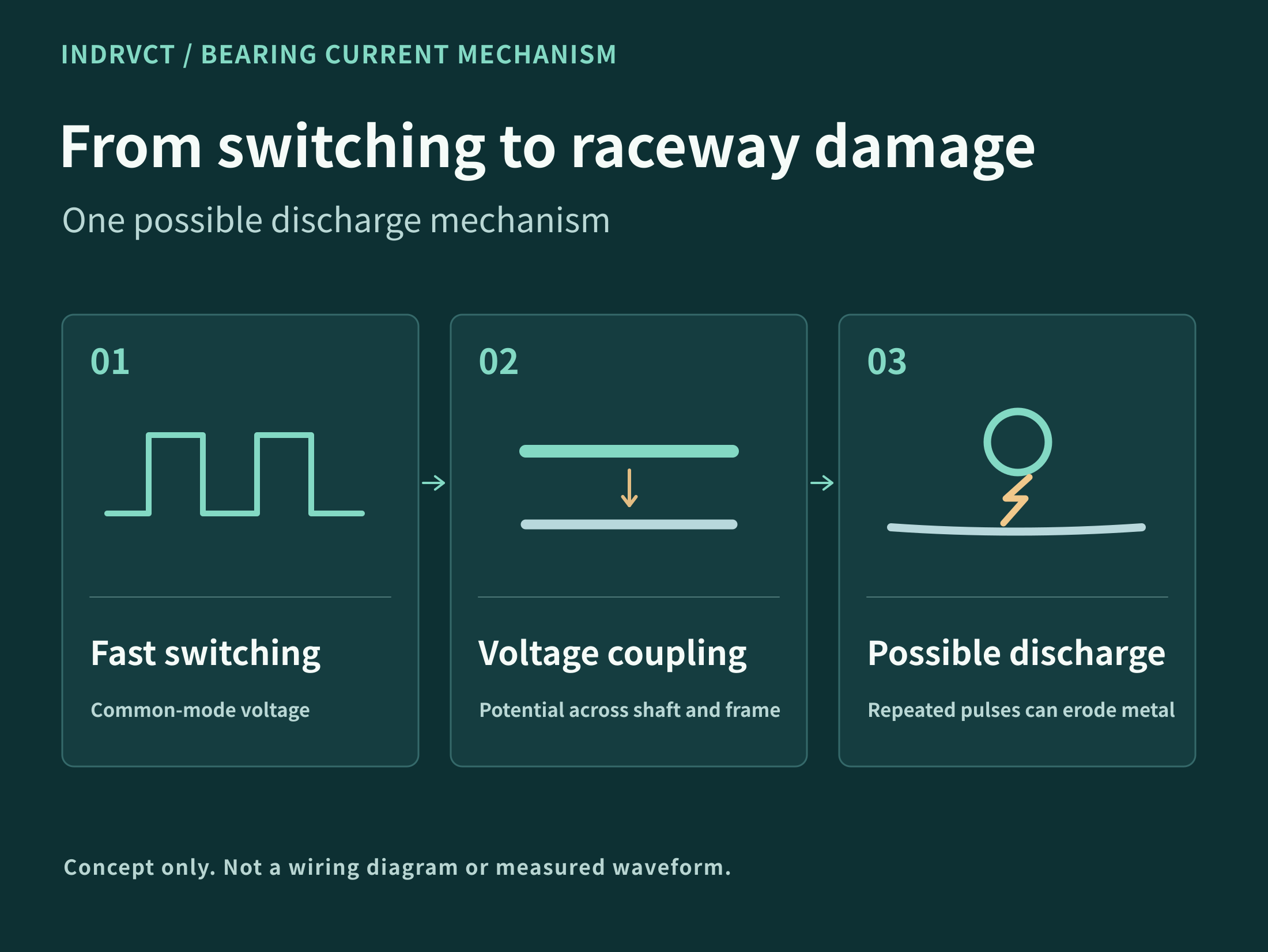
A variable frequency drive (VFD) creates the motor output through rapid switching. The resulting common-mode voltage can couple through the motor's internal capacitances and contribute to a voltage between the shaft and frame. Under some conditions the thin lubricant film in a bearing cannot withstand the voltage across it, so a discharge crosses a rolling contact. Many discharges can roughen a raceway or rolling element over time.
This is one mechanism, not the entire model. Depending on motor construction and the system's high-frequency return paths, current can circulate through more than one bearing or find a path from the motor shaft into the driven equipment. A shaft can have measurable voltage without a particular bearing being damaged. The rotating assembly, cable, frame bonding and connected machine all belong in the review.
Why a quiet drive display does not rule it out
The drive display usually tells you about the quantities it monitors, such as output current or a trip. It does not establish what is happening at a bearing contact. Conversely, an audible tone during an otherwise normal run does not establish electrical erosion. Repeated failures at a similar service interval or in several comparable machines under similar conditions are a reason to compare evidence, not a diagnosis by themselves.
How can you distinguish electrical erosion from mechanical wear?
With electrical erosion, a shop may find a matte or frosted contact surface, small discharge craters under magnification or a washboard-like band pattern known as bearing fluting. The appearance varies with the damage stage and the mechanism. Look beyond a single photograph: the raceways, rolling elements, grease and pattern location can provide complementary evidence. Ask the shop to separate its observation from its proposed cause.
Mechanical faults can leave superficially similar marks. With a stationary machine subject to vibration, false brinelling can leave marks at rolling-element spacing. Poor lubrication or contamination can produce rough, discolored wear tracks, and misalignment may put the load where the bearing was not designed to carry it. Alignment, fits, lubrication and operating temperature deserve a review even when a drive is present. More than one mechanism can be active at the same time.
What to preserve during the repair
| Evidence to keep | What it helps distinguish |
|---|---|
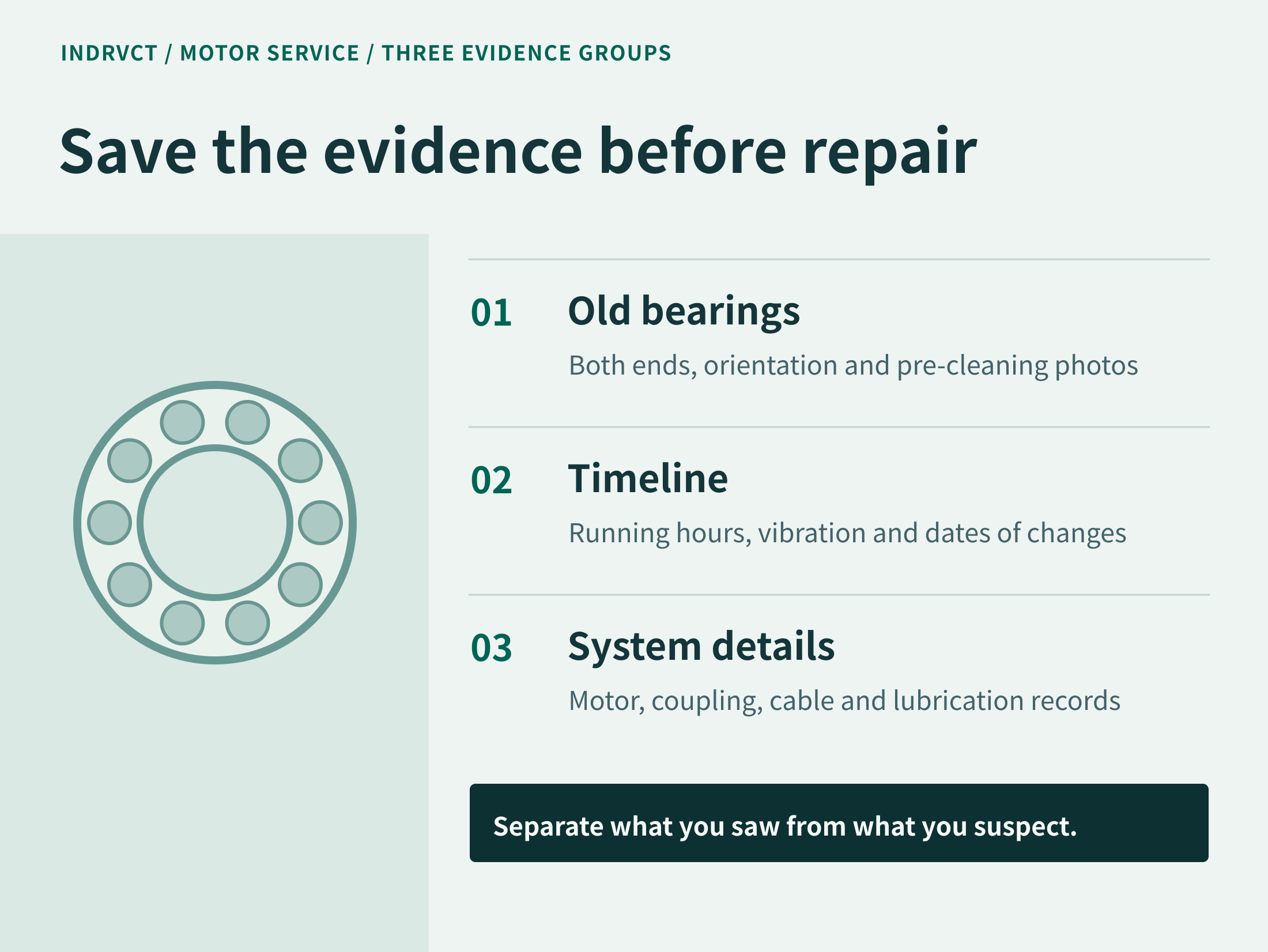
| Photos of both ends before cleaning, with orientation and early close-ups | Whether the damage is concentrated on a particular bearing, in a loaded area or across several surfaces |
| Operating hours, vibration or noise history, and the date anything changed | An isolated event, a problem that predates the retrofit, or a repeatable pattern after a change |
| Motor and bearing identification, grease condition, and the coupling arrangement | Lubrication, loading and assembly issues that can resemble or coexist with current damage |
| A record of cable length, routing changes, shielding and bonding configuration | Whether the electrical team should review the high-frequency return path |
Keep the parts identified by machine and end. Mixing parts from two motors or washing the raceway before documentation can erase meaningful distinctions. If the last repair kit is available, include its date and any photos from that repair. A recurring failure is easier to compare when the first set of observations is still available.
What evidence should guide the choice of remedy?
Start with a case comparison. Does the problem occur only after a recent control change? Is the same bearing position affected on similar equipment? Can the driven machine's own bearings show a pattern? Compare like operating states and note where the comparison is imperfect. A long motor cable or a new inverter is a clue, but neither is proof of a causal pathway.
If evidence points toward electrical erosion, ask qualified specialists to assess the motor, cable, bonding and driven equipment together. Relevant high-frequency shaft-voltage or current measurements require an appropriate setup and a safe work procedure. A general-purpose meter reading or one snapshot at an undocumented speed and load does not confirm or rule out the mechanism. Where a baseline is needed, compare the same measurement conditions after a reviewed change.
For example, consider two otherwise similar machines that received new drives at the same time. If only one has a shortened bearing life, check whether the motors, cable routes and maintenance history are really comparable. One might have had a motor replaced and a cable rerouted during the same shutdown. If the affected machine already had a rising vibration trend before the retrofit, that also matters. Record differences rather than filing the two machines under the same description. The case is stronger when the bearing evidence and a verified electrical path point to the same explanation.
If the failed parts have already been discarded, record that gap explicitly. A future inspection may still be justified, but without the old bearings it will be harder to connect current measurements to the previous failure. Preserve the next inspection record rather than retroactively classifying an unverified failure.
Match the mitigation to the return path
The options do different jobs. Reviewed shielding and high-frequency protective bonding can improve a return path. A shaft grounding device can divert some currents when well selected and maintained. An insulated or hybrid bearing can interrupt a particular path; that does not guarantee that current cannot move through another bearing or the coupled machinery. A suitable common-mode or output treatment is another system-level option. Do not choose one from a photo or assume it is compatible with every motor and drive.
Compare planned remedies when evaluating industrial AC drives with the motor supplier and machine builder. Ask what path the change addresses, what inspection or maintenance it adds and how success will be judged. A good corrective-action record separates the observed damage, likely cause and verification plan. Keep follow-up vibration observations and operating hours so an apparent short-term improvement is not mistaken for a lasting fix. If the old bearings typically failed after several months, a quiet acceptance run is useful as a baseline, not as a completed durability check. Also note whether a repair changed several things at once so the result is not attributed to one component without evidence.
Frequently Asked Questions
Does bearing fluting prove that the drive is faulty?
No. A fluted raceway can support an electrical-erosion investigation, but appearance alone does not identify the electrical path or demonstrate a defective drive. Review the motor, cable, bonding, coupling and competing mechanical explanations before attributing cause.
Will a new bearing or a shaft grounding ring solve every repeat failure?
No. A replacement restores the worn component without necessarily removing the cause. A grounding device can address certain current paths and requires its own installation and maintenance review. Choose an intervention after confirming the likely mechanism, and compare like operating conditions afterward.
What should I send for a technical discussion?
Collect the operating timeline, bearing photos, motor and cable information, and any changes made since the equipment last ran normally. Then contact INDRVCT to discuss which drive-side information is still needed. Keep mechanical evidence in the same record so that the teams are solving the same problem.